

Isotropic antenna based on Rydberg atoms
Our research group has achieved a breakthrough in isotropic antenna technology based on Rydberg atoms. The related findings have been published in Optics Express under the title "Isotropic Antenna Based on Rydberg Atoms". Dr. Shaoxin Yuan from our team served as the first author, with Lecturer Jing Mingyong as the corresponding author. Associate Professor Hao Zhang, Professor Linjie Zhang, Professor Liantuan Xiao, and Professor Suotang Jia contributed to this research.
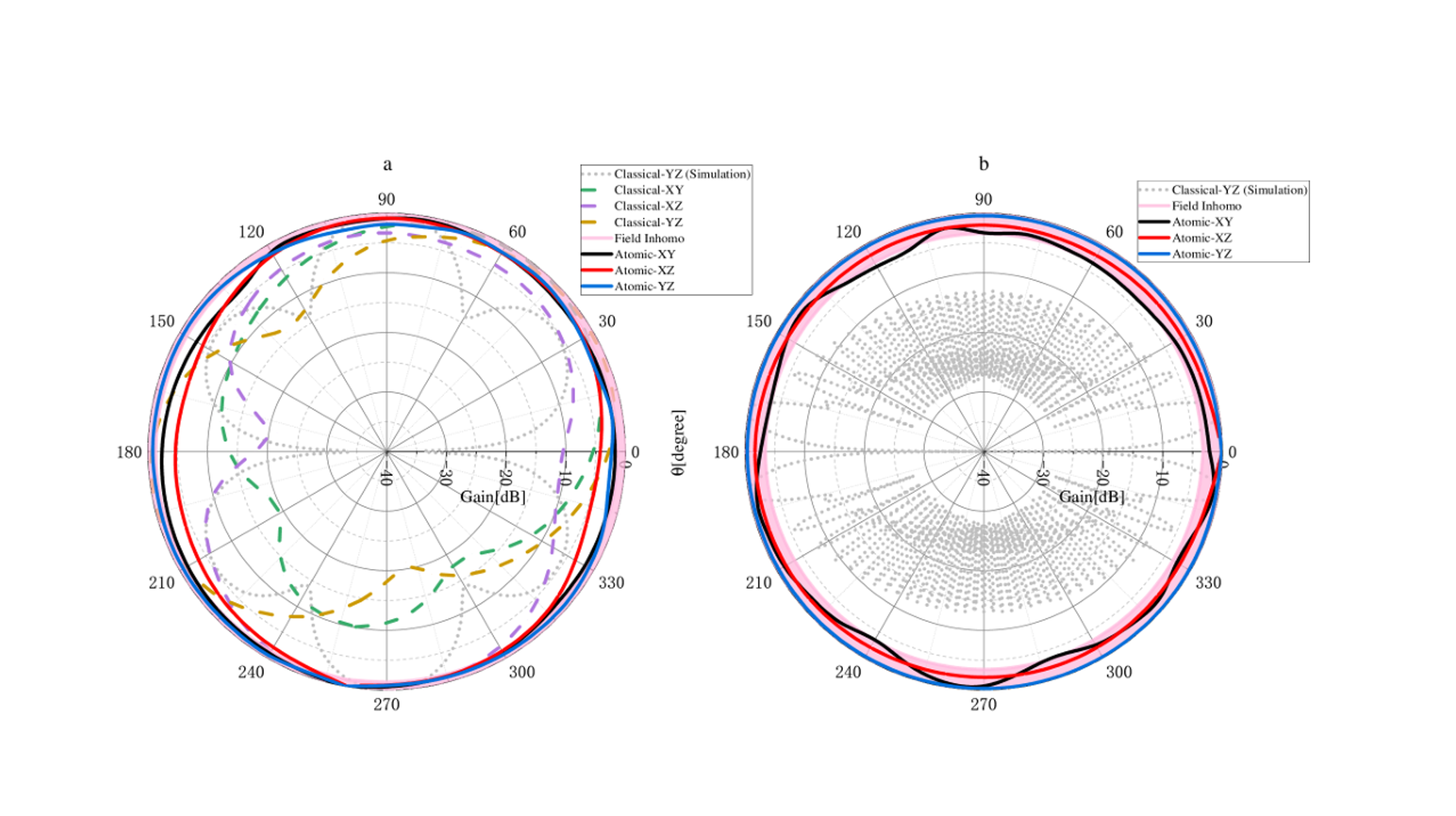
Our research group has proposed and experimentally validated an isotropic antenna scheme based on Rydberg atoms, overcoming the fundamental limitation of classical metallic antennas constrained by the "hairy ball theorem" that precludes ideal isotropic responses. Theoretically, we demonstrate that when radio-frequency fields couple two Rydberg levels with distinct angular momenta, the measured field strength becomes direction-independent, enabling zero isotropic deviation in principle. This conclusion applies not only to the J=1/2 and J=3/2 level structures but extends to other quantum state configurations. Experimentally, we conducted verification in microwave (4.8 GHz) and terahertz (0.1296 THz) regimes using cesium vapor through electromagnetically induced transparency (EIT) and Autler-Townes splitting measurement methodologies.Experimental results demonstrate that the atomic antenna achieves a maximum isotropic deviation below 5 dB over the full solid angle while attaining a minimum deviation of 0.28 dB in single-plane measurements, representing at least a 15 dB improvement compared to classical antennas which typically exhibit deviations exceeding 20 dB. The residual experimental deviations primarily originate from imperfect experimental conditions, electric field inhomogeneities within vapor cells, and positioning errors during rotation; optimization through approaches such as spherical vapor cell implementation could potentially reduce deviations below 0.3 dB. Crucially, the measurement formalism relies exclusively on frequency determination, enabling direct traceability to the Planck constant and inherently combining SI traceability with ultrawideband capabilities. These findings not only demonstrate the distinct advantage of quantum sensors in achieving ideal isotropic responses but also establish new technological pathways for applications in radio-frequency electrometry, antenna calibration, and full-space-coverage communications.